Fuel costs account for about half of the glass production cost. Replacing heavy oil with relatively inexpensive petroleum coke can significantly reduce production costs. However, much of the petroleum coke used in the glass industry is imported, and much of it is cheap petroleum coke that cannot be used abroad, containing large amounts of sulfur and vanadium. After replacing heavy oil with petroleum coke, the change in thermal regime, especially the alteration of slag composition and acidity/alkalinity, significantly impacts the lifespan of refractory materials, particularly those used in regenerators. The lifespan of checker bricks drops sharply from 10 years to 2-5 years, or even less than 1 year. To improve the service life of the checker bricks in glass kilns’ regenerators, this study first investigated the chemical composition and alkali-to-sulfur ratio of glass kiln slag after the use of petroleum coke, the damage mechanism of magnesia bricks remaining in the regenerator checker bricks, and the resistance of directly bonded magnesia-chrome bricks, electrofused rebonded magnesia-chrome bricks, and electrofused rebonded high-purity magnesia-alumina spinel bricks to glass kiln slag erosion. Based on this, a series of targeted countermeasures was implemented, significantly improving the lifespan of the checker bricks.
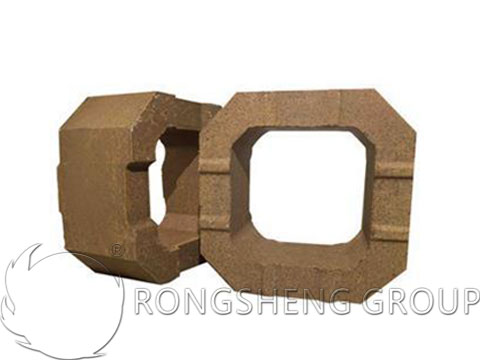
Replacement of Magnesia Bricks in the Regenerator Chamber of Glass Furnaces
Based on changes in slag composition and their erosion effects and mechanisms on magnesia bricks, directly bonded magnesia-chrome bricks, electrofused rebonded magnesia-chrome bricks, and electrofused rebonded high-purity magnesia-alumina spinel bricks, corresponding countermeasures were implemented in three phases:
- Phase 1: Controlling the glass production process and petroleum coke quality, and replacing 95 magnesia checker bricks with 97 magnesia checker bricks and directly bonded magnesia-chrome bricks.
- Phase 2: Replacing directly bonded magnesia-chrome bricks with electrofused rebonded magnesia-chrome bricks, and increasing the amount of electrofused magnesia sand in the 97 magnesia bricks.
- Phase 3: Developing personalized solutions based on the user’s specific needs, providing the optimal matching scheme with a balanced cost-performance ratio.
Through the gradual implementation of the above countermeasures and measures, the service life of the regenerator checker bricks gradually increased.
Because the glass plant initially used Al2O3 and substances containing B2O3 and P2O5 as fluxes, it caused erosion of the alkali checker bricks and blockage of the checker bricks. The use of these substances was stopped or significantly reduced. Since creep caused by erosion of 95 magnesia bricks is the main cause of checkerboard damage, the 95 magnesia bricks in the upper layer of the checkerboard were removed, and the top layer was expanded to use 97 magnesia bricks, while the middle layer was expanded to use directly bonded magnesia-chrome bricks. These adjustments alleviated the problem of excessively short lifespan of the checkerboard bricks in the glass kiln regenerator to some extent.
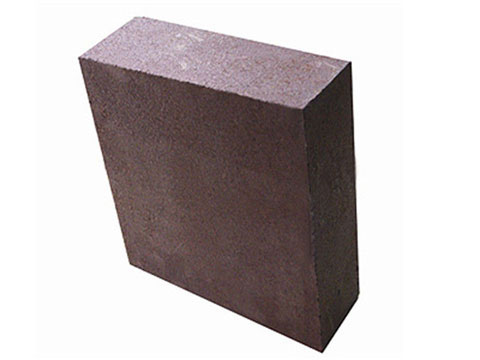
Because 97 magnesia bricks and directly bonded magnesia-chrome bricks have insufficient erosion resistance, a larger amount of fused magnesia sand and a high-temperature firing process were used in the manufacture of 97 magnesia bricks. Secondly, fused rebonded magnesia-chrome bricks were used to replace the less erosion-resistant directly bonded magnesia-chrome bricks. Due to the good structural stability of fused rebonded materials, their erosion resistance and service life are significantly better than similar products using sintered sand. Using fused rebonded magnesia-chrome bricks instead of directly bonded magnesia-chrome bricks can further increase the service life of the checkerboard by 150%.
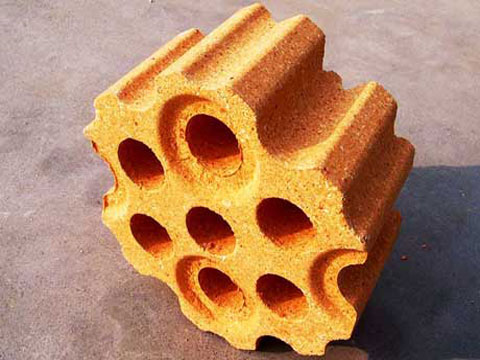
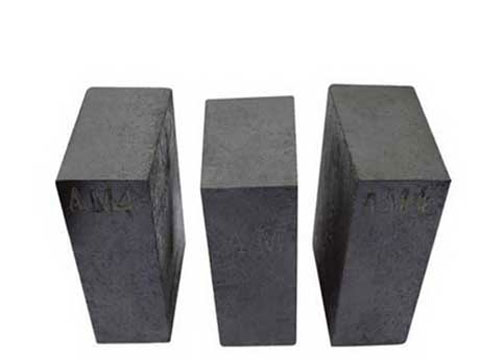
Magnesia bricks for the regenerator lattice of a glass kiln
(1) The characteristics of glass ash determine the damage mechanism of refractory materials. When the ash is alkaline (containing free Na2O), alkaline refractory materials should be used. When it is acidic (containing free SO3), neutral refractory materials such as alumina-chrome bricks can be used.
(2) When using petroleum coke, the calorific value, volatile matter, ash content, moisture, sulfur content, and vanadium content of the petroleum coke, as well as the sulfur and alkali content of the regenerator ash, should be tested to select suitable refractory materials and control the glass production process.
(3) When conditions permit, magnesia checker bricks should be produced using fused magnesia and a three-high process (high-purity raw materials, high-pressure molding, and high-temperature firing). The application range of magnesia-chrome bricks should be expanded, and fused rebonded magnesia-chrome bricks should be used instead of directly bonded magnesia-chrome bricks as regenerator checker bricks. Depending on the application conditions, high-temperature fused magnesia-zirconium bricks, chrome corundum bricks, or chrome-zirconium corundum bricks can be used for the top layer and some upper layers.