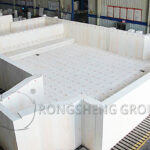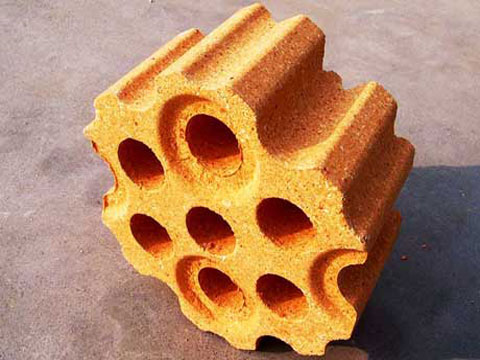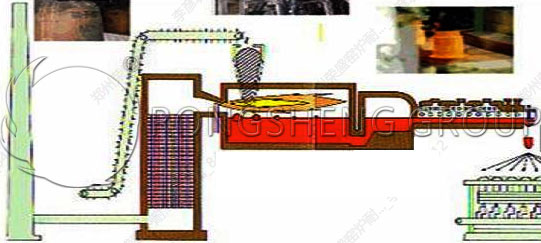
Regenerator: The regenerator is actually a waste heat recovery device – part of the exhaust gas waste heat utilization system. The regenerator is part of the exhaust gas waste heat utilization system. It uses refractory materials as regenerators (called checker bricks) to store part of the heat of the flue gas discharged from the kiln and use it to heat the air entering the kiln. When the high-temperature exhaust gas in the kiln flows through the grid body of the regenerator, the checker bricks are heated. In this process, the temperature of the checker bricks gradually increases. The heat stored in the grid body will heat the gas or air flowing through the grid bricks after the flame is turned, thereby ensuring that the flame has a high enough temperature to meet the needs of glass melting. During this process, the temperature of the checker bricks gradually decreases, and so on. Therefore, the function of the regenerator is to absorb and store the heat contained in the exhaust gas through the checker bricks, and then transfer it to the air and gas, heating them to a certain temperature to achieve the purpose of saving fuel and reducing costs.
The temperature of the waste gas in the glass melting furnace when it is discharged from the kiln is about 1400-1500°C. The gas can be preheated to 800-1000°C, and the air can be preheated to 1000-1200°C. The temperature of the waste gas when it is discharged from the regenerator is about 600°C.
Structure of the Regenerator
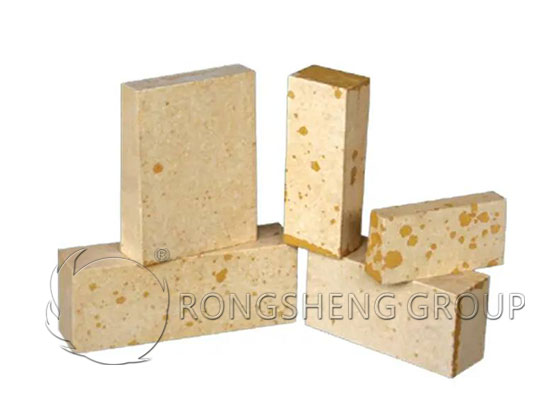
The regenerator consists of a roof arch, inner and outer side walls, end walls, partition walls, latticework, and furnace bars. The roof arch thickness of a float glass melting furnace regenerator is generally equal to or greater than 350 mm and is constructed with high-quality silica bricks, with a central angle of 90°–120°, depending on the specific situation. The side walls, end walls, and partition walls are generally 580 mm thick, typically constructed with low-porosity clay bricks at the bottom, and alkaline refractory materials at the middle and upper parts; some use siliceous materials for the upper part.
Types of Regenerators
To improve the heat storage performance and service life of regenerators, various types are used both domestically and internationally. However, for float glass melting furnaces in China, the most common types include interconnected structures, partitioned structures, semi-partitioned structures, interconnected structures of two small furnaces, two-section structures, and fully interconnected structures.
In an interconnected structure, the air regenerator chamber below the small furnace on one side of the melting furnace is a single interconnected chamber, and the gas regenerator chamber is also a single interconnected chamber. This type of structure, due to uneven airflow distribution, is prone to localized overheating, causing the checker bricks to burn out quickly, and is now rarely used.
The partitioned structure divides the regenerator chamber into individual furnace units, preventing gas exchange between chambers. Gas distribution is regulated by dampers on branch flues within each chamber. The advantages of this structure are convenient gas distribution regulation and easy thermal repair of the checker. However, the increased number of partitions reduces the volume of the checker, resulting in a smaller heat exchange area and lower thermal efficiency.
The semi-partitioned structure divides the flue above the grate of the regenerator chamber into individual small furnaces, without partitioning the regenerator chamber itself. The gas distribution regulating dampers remain on the branch flues.
The two-furnace interconnected structure divides each small furnace into a chamber, with each small furnace having its own branch flue for gas distribution regulation. Compared to the partitioned structure, this structure reduces the number of partitions, increases the heat exchange area of the checker, and improves thermal efficiency. However, the reduced number of partitions results in slightly lower sidewall stability. Furthermore, the interconnected nature of the two regenerators presents challenges for hot repair of the grid structure, requiring simultaneous repair of both small furnaces, which severely impacts production. This type of regenerator is currently widely used in large float glass melting furnaces.
The two-section structure divides a single regenerator into two separate chambers separated by a partition wall and connected by a vertical channel, effectively dividing the regenerator into a high-temperature zone and a low-temperature zone. This structure primarily prevents the erosion of the grid bricks by the gas-liquid-solid transformation of sodium sulfate, ensuring this transformation occurs within the connecting channel to extend the lifespan of the grid bricks. Due to its complexity, this type of structure is rarely used nowadays.
The fully interconnected structure connects the entire regenerator on one side of the melting furnace into a single chamber, while branch flues are provided for each small furnace to regulate gas distribution. This structure maximizes the heat exchange area of the grid structure, resulting in high thermal efficiency. However, due to the lack of a partition wall, the sidewall stability is poor; if local grid bricks collapse or become blocked, hot repairs become impossible. Currently, this type of regenerator is also used in large float glass melting furnaces.
Furnace Bars
Furnace bars are refractory material structures that bear the weight of the lattice structure. In fact, it is also an arch structure, but composed of individual arch bricks arranged in rows, with gaps between the bars for ventilation, hence the name “furnace bar arch.” Since the furnace bar arch bears the weight of the lattice structure (on which the lattice bricks are stacked), it must be leveled. There are two methods for leveling: one is to level the arch with mortar bricks, and the other is to directly construct it using arch bricks that are flat on top and curved at the bottom.
The width and height of the furnace bar arch are determined by calculations based on the weight of the lattice structure supported by the bars. Generally, the width should not be less than 150mm, the height not less than 300mm, and the spacing between each bar not less than 150mm. To increase the stability and overall integrity of the individual bars, two reinforcing ribs are usually added to the furnace bar arch. The refractory material for the grate section is generally constructed using low-porosity clay bricks.
Grid Structure
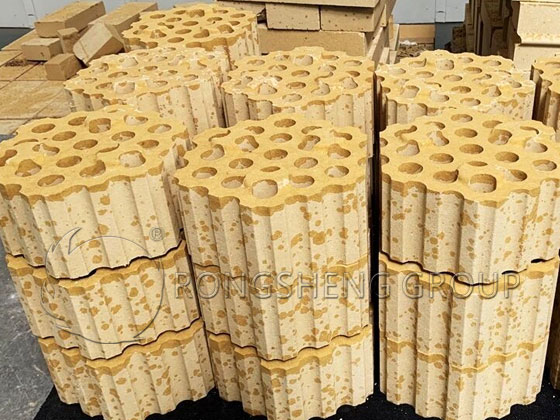
The grid structure is the heat transfer section of the regenerator and is the most important component of its structure. The rationality of the grid structure not only affects the service life of the regenerator but also directly impacts its heat storage efficiency, thus affecting the overall thermal efficiency of the furnace. Therefore, the refractory material composing the grid must be heat-resistant, corrosion-resistant, have high heat storage capacity, rapid heat transfer, and good thermal shock stability, and the entire grid structure must possess excellent structural stability.