Refractory materials are widely used in high-temperature industries such as steel smelting, cement, ceramics, glass, power, non-ferrous metals, and chemical industries, serving as fundamental supporting materials in these sectors. In harsh working environments, refractory materials are subjected to the combined effects of high-temperature gaseous, solid, and liquid substances. On one hand, molten slag and other substances corrode the material surface. On the other hand, thermal stress damage is also a major cause of damage to refractory materials. Therefore, refractory materials require excellent corrosion resistance and high-temperature resistance.
Minor damage, such as cracks that occur during the preparation of alumina refractories, Alumina Bricks, poses a potential safety risk. To improve the material’s performance, the effects of factors such as model size, heat treatment temperature, heating rate, cooling rate, and porosity on crack formation in alumina refractories during the firing process were investigated.
Thermal Stress Values at Different Sizes
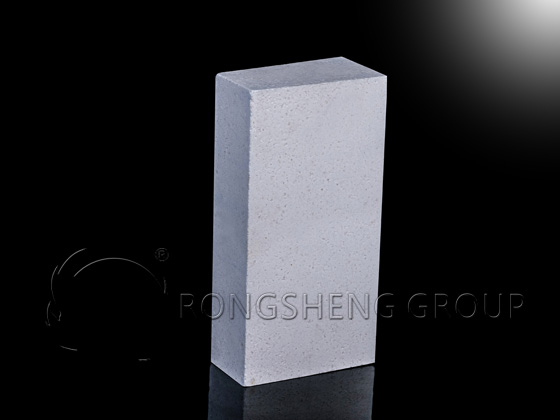
Alumina Bricks, with brick sizes of 70mm×15mm, 70mm×20mm, and 70mm×25mm. The temperature was increased from room temperature (20℃) to 1600℃. The heating rate at each stage of the temperature increase from 20℃ to 1600℃ was used to calculate the temperature and thermal stress fields of the brick. A thermal stress distribution cloud map of the 70mm×15mm brick at 1600℃ is shown. The maximum thermal stress value is distributed at the center of the brick, exhibiting tensile stress, and the thermal stress value decreases from the center to the surface. The minimum thermal stress value is distributed on the upper surface, exhibiting compressive stress.
A thermal stress distribution cloud map at 1600℃ is shown. The trend of maximum thermal stress values for the three brick sizes (70mm×15mm, 70mm×20mm, and 70mm×25mm) at 1600℃ is also shown. As temperature increases, the maximum thermal stress values for each size exhibit a trend of first increasing and then decreasing, with the peak occurring in the temperature range of 1200℃ to 1400℃. At the same temperature, the maximum thermal stress value increases with the increase in brick size. The flexural strength of alumina refractories at 1400℃ and 1460℃ is 30MPa and 11MPa, respectively. When the kiln temperature rises to 1400℃, the maximum thermal stress values for all three brick sizes do not exceed 30MPa, indicating a low probability of cracking. When the temperature rises to 1460℃, only the maximum thermal stress value for a 70mm × 15mm brick does not exceed the flexural strength of alumina.
Therefore, the larger the brick size, the greater the maximum thermal stress value, and the greater the probability of cracking. Thus, appropriately reducing the size of alumina bricks can reduce the risk of cracking. Maximum thermal stress variation curves for alumina bricks of different sizes.
Thermal stress values at different heat treatment temperatures.
Trends of maximum thermal stress values with temperature at different heat treatment temperatures. When the firing temperature in the kiln increased from room temperature to 1600℃, 1650℃, 1700℃, 1750℃, and 1800℃, the corresponding maximum thermal stress values inside the alumina brick blanks were 8.03 MPa, 8.02 MPa, 5.48 MPa, 4.91 MPa, and 4.80 MPa, respectively. Within the 200℃~600℃ range, the maximum thermal stress value changed slowly. Within the 600℃~1200℃ range, the maximum thermal stress value changed significantly. After reaching 1600℃, further heating showed a decreasing trend in the maximum thermal stress value. This is because, after reaching 1600℃, further heating reduces the temperature difference between the interior and surface of the refractory material, resulting in a decrease in the corresponding maximum thermal stress value. (Maximum thermal stress values of alumina brick blanks at different heat treatment temperatures.)
Thermal Stress Values at Different Heating Rates
During the firing process of refractory materials, thermal stress is highly sensitive to temperature changes within the temperature range of 1000℃ to 1350℃. Therefore, the heating rate was kept constant in other temperature ranges, with the heating rates set to 20℃/min, 25℃/min, 30℃/min, 35℃/min, and 40℃/min for the 1000℃ to 1350℃ temperature range, respectively. Heating rate settings for alumina brick blanks in different temperature ranges. Trends in maximum thermal stress values under different heating rates.
1) Within the 1000℃ to 1600℃ temperature range, as the temperature increases, the maximum thermal stress values at heating rates of 30℃/min, 35℃/min, and 40℃/min first increase, reaching a peak in the 1200℃ to 1400℃ temperature range, and then decrease.
2) Under heating rates of 20℃/min and 25℃/min, the maximum thermal stress shows a trend of first decreasing, then increasing, and finally reaching its maximum value. 3) Under different heating rates, the maximum thermal stress value inside the material tends to be consistent when the ambient temperature inside the kiln reaches 1600℃.
4) The faster the heating rate, the more significant the change in maximum thermal stress value with temperature. Considering the high probability of crack formation in the blank under these conditions, the heating rate should be appropriately reduced to avoid crack formation. Maximum thermal stress variation curves of alumina brick blanks at different heating rates.
Thermal stress values at different cooling rates
The minimum thermal stress value is compressive stress, distributed in the center of the brick blank; the maximum thermal stress value is tensile stress, mainly distributed in the center of the upper surface of the brick blank. This is similar to the thermal stress distribution of chromium oxide blanks during cooling. During cooling, the surface temperature drops faster and shrinks more, thus the surface is subjected to tensile stress. The internal temperature of the material drops slowly, and the stress situation is reversed, subjected to compressive stress. Thermal stress distribution of the brick blank when cooled to room temperature at a rate of 10℃/min. Trend of maximum thermal stress value variation under different cooling rates. Within the temperature range of 1400℃ to 1600℃, the maximum thermal stress increases rapidly as the temperature decreases. The thermal stress reaches its maximum value within the range of 1200℃ to 1400℃. This indicates that this temperature range is a dangerous stage for cracking or fracture of the brick blank; therefore, the cooling rate of the brick blank within this range should be strictly controlled. After the temperature reaches 1200℃, the maximum thermal stress value decreases slowly, and the lower the cooling rate, the lower the corresponding maximum thermal stress value. The curves showing the change in maximum thermal stress under different cooling rates are presented.
Thermal Stress Values with Different Porosities
The variation trend of maximum thermal stress values in alumina brick blanks under different porosity settings. The variation trends of brick blanks with three porosities are consistent at various temperatures. The maximum thermal stress value is observed at 1300℃ in the curve. At the same temperature, the maximum thermal stress value is the lowest for brick blanks with a porosity of 10%. Therefore, it can be considered that, comparatively, a porosity of 10% in the brick blank is beneficial in avoiding crack formation. The variation trend of maximum thermal stress under different porosities.
The results show that:
As the alumina brick size increases, the corresponding maximum thermal stress value also increases, and the risk of crack formation also increases. The peak value of the maximum thermal stress occurs in the temperature range of 1200~1600℃.
When only the heating rate within the temperature range of 1000~1350℃ is changed, the higher the heating rate, the greater the corresponding maximum thermal stress value.
When the kiln cools from 1600℃ to room temperature, the maximum thermal stress value increases rapidly in the initial stage of cooling, and the higher the cooling rate, the greater the corresponding maximum thermal stress value.
For alumina brick blanks with 5%, 7%, and 10% porosity, under the same firing conditions, the maximum thermal stress values of the 10% porosity brick blank were the lowest at 1200℃, 1300℃, 1400℃, and 1500℃. Therefore, brick blanks with 10% porosity are more beneficial than those with 5% and 7% porosity in reducing the risk of cracking during firing.