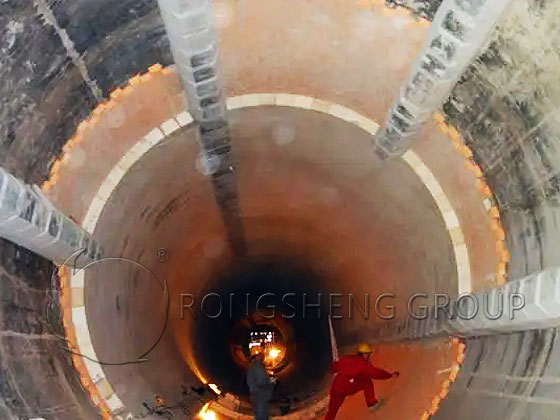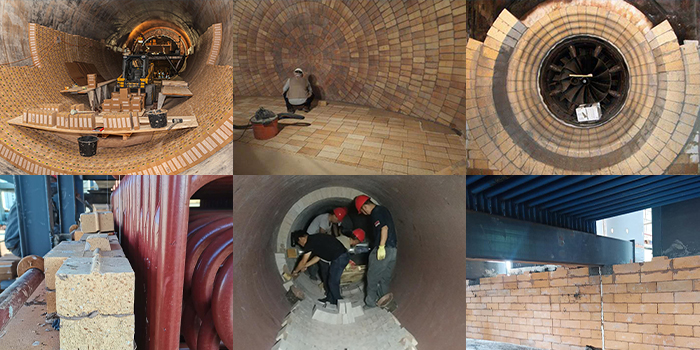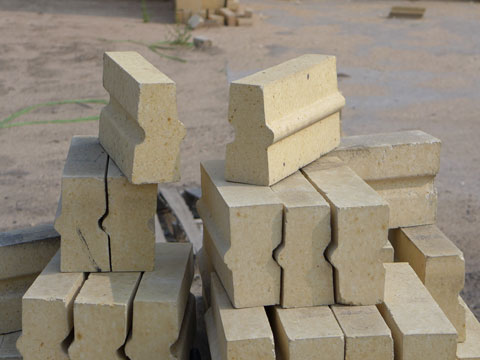
The insulation layer of a kiln lining serves to protect the furnace shell and save energy. Lightweight insulating refractory bricks, lightweight insulating castable fiberboard, and other materials are commonly used for this purpose.
Because lightweight insulating refractory bricks or castables have larger pores than heavyweight materials, they are prone to shrinkage and deformation under heat. Therefore, different materials of insulating refractory bricks or castables must be selected for different temperature conditions to maintain the stability of the insulation layer within the furnace lining. Shrinkage can lead to deformation or cracking of the insulation layer inside the furnace, increasing heat loss. Therefore, the selection of lightweight insulating firebrick or insulation materials primarily depends on their ability to resist shrinkage and deformation under heating. The operating temperature of insulating refractory bricks generally increases with increasing bulk density. Excessively high bulk density actually reduces insulation performance. Low bulk density provides good insulation but has very low strength, making it extremely prone to spalling.
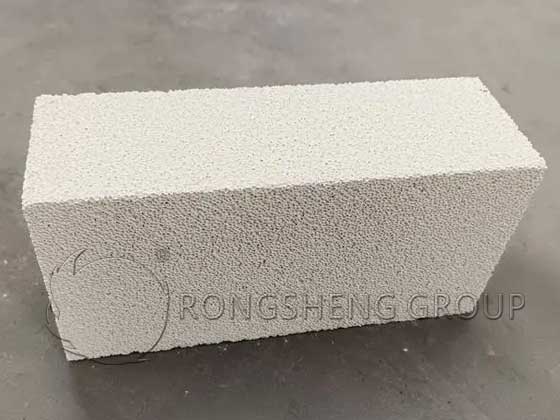
Applicable Temperatures of Thermal Insulation Refractory Bricks or Castables
In other words, for different temperatures, it’s necessary to select thermal insulation bricks, castables, or fiber materials suitable for their operating temperature. Below are the suitable temperatures for different thermal insulating firebricks or castables for reference:
- Slag wool: 600℃;
- Perlite insulation material: 50-1000℃;
- Calcium silicate insulation board: 650-1000℃;
- Vermiculite insulation material: 1000-1150℃;
- Diatomaceous earth thermal insulation bricks: 1000-1200℃;
- Refractory ceramic fiber: 1000-1300℃;
- Calcium feldspar lightweight thermal insulation bricks: 1100-1300℃;
- Lightweight clay thermal insulation bricks: 1000-1350℃.
- Lightweight high-alumina insulating bricks are suitable for temperatures of 1350-1500℃.
- Lightweight silica insulating bricks are suitable for temperatures of 1500-1550℃.
- Polycrystalline alumina fiber insulating bricks are suitable for temperatures of 1400-1600℃.
- Mullite lightweight insulating refractory bricks are suitable for temperatures of 1350-1650℃.
- Lightweight corundum insulating bricks are suitable for temperatures of 1650-1800℃.
- Alumina hollow sphere insulating bricks are suitable for temperatures of 1650-1800℃.
- Zirconium oxide fiber and hollow sphere insulating bricks are suitable for temperatures of 1800-2000℃.
Lightweight Refractory Bricks for Industrial Kiln Insulation
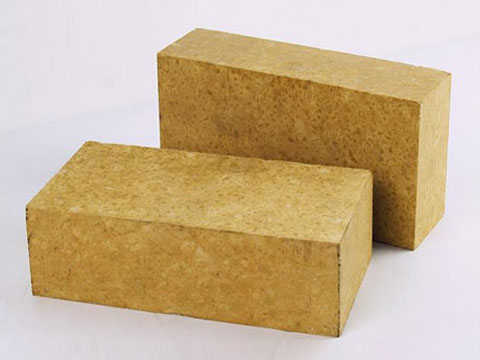
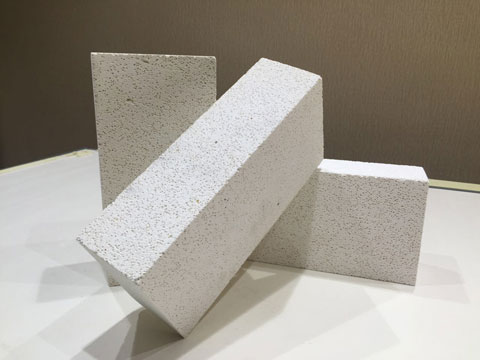
Lightweight refractory bricks can be made from raw materials such as clay, silica, alumina, and mullite. Their insulating properties are due to the large number of pores (both closed and open) within the brick. These pores are created through methods such as adding combustible materials, foaming, and chemical methods. Lightweight insulating firebricks have low compressive strength, poor slag resistance, and poor thermal shock resistance, and cannot be in direct contact with molten glass or flames.
Lightweight Clay Insulating Bricks
Lightweight clay insulating bricks are refractory products made primarily from refractory clay, with an Al2O3 content of 30%–48%. Their production process employs the burnout additive method and the foaming method. Using refractory clay, clinker, and refractory clay clinker as raw materials, along with binders and sawdust, the process involves batching, mixing, shaping, drying, and firing to obtain a product with a bulk density of 0.3–1.5 g/cm³. Lightweight clay insulating bricks account for more than half of the total production of insulating firebricks.
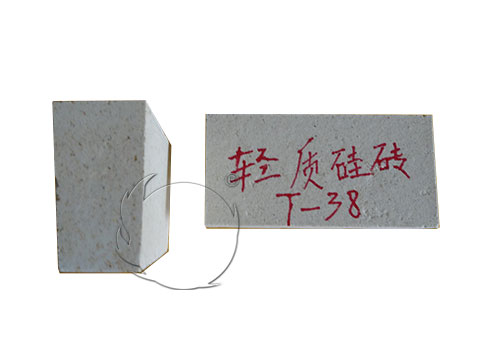
Lightweight Silica Insulating Bricks
Lightweight silica insulating bricks are insulating refractory products made primarily of silica, with a SiO2 content of not less than 91%. The bulk density of lightweight silica insulating bricks is 0.9–1.1 g/cm³, and their thermal conductivity is only half that of ordinary silica bricks. They have good thermal shock resistance, and their load softening initiation temperature can reach 1600℃, far exceeding that of clay insulating bricks. Therefore, the maximum service temperature of silica insulating firebricks can reach 1550℃. They do not shrink at high temperatures and even exhibit slight expansion.
Lightweight Alumina Insulating Bricks
Lightweight alumina insulating bricks are insulating refractory products made primarily of fused alumina, sintered alumina, and industrial alumina. Their production processes include the foaming method and the burnout additive method.
Lightweight Mullite Insulating Bricks
Lightweight mullite insulating bricks are heat-insulating and refractory products made primarily of mullite. Mullite insulating bricks are heat-resistant, high-strength, and have low thermal conductivity, allowing direct contact with flames. They are suitable for the linings of various industrial kilns.